
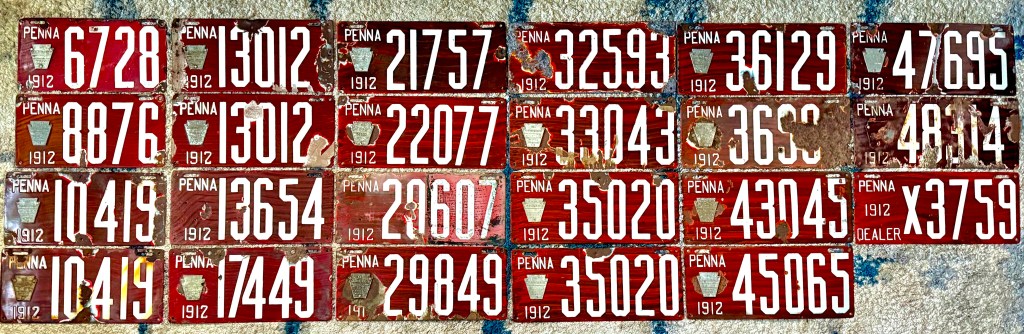
My favorite license plate that I’ve collected is the 1912 issue from the state of Pennsylvania. It has a unique “woodgrain” appearance that was hand-painted at the time of production. Only one other state created a plate like this – Ohio in 1910.
Background
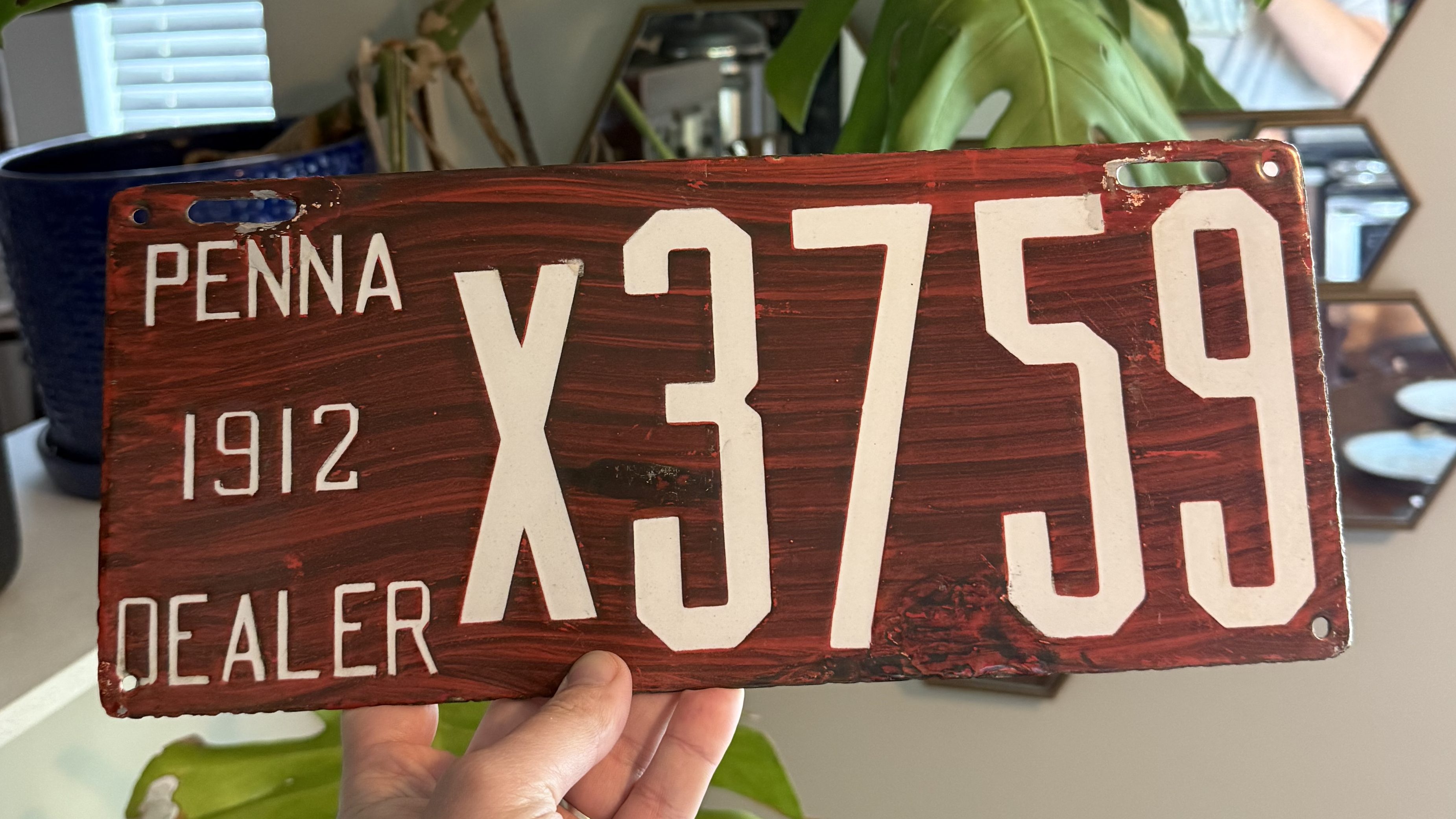
I’m by no means the expert on this topic, but through my research I’ve learned quite a bit about the manufacturer of the 1912 plate – Brilliant Manufacturing Company. From the start of the state-issued passenger license plates in 1906, Pennsylvania had a contract with the Ingram Richardson Manufacturing Company (Ing-Rich), one of the biggest names in the game at that point. Ing-Rich had some trouble with poor-quality license plates produced for the 1911 year, and PA officials sought out a new company for 1912. Brilliant was a relatively unknown, small business based in Philadelphia. They took on the very tall order of nearly 60,000 pairs of porcelain plates for the 1912 year. In my opinion, they under-promised and over-delivered, developing a highly popular and attractive burgundy “woodgrain” style plate. The production was received well by the state of PA, and they retained Brilliant’s contract through the end of the porcelain license plate years in PA – 1915. Brilliant even produced the painted steel plates of 1916, at which point Pennsylvania moved to the prison-production system. Brilliant also had contracts with other states, and made assorted signs and wares for several decades after the porcelain run. For more information about Brilliant, check out this excellent resource.
Current research:
Prepare to get really into the weeds about a specific year of license plate issued by the state of Pennsylvania!
I’ve been researching a few specifics of the 1912 production process.
Stamps on reverse:
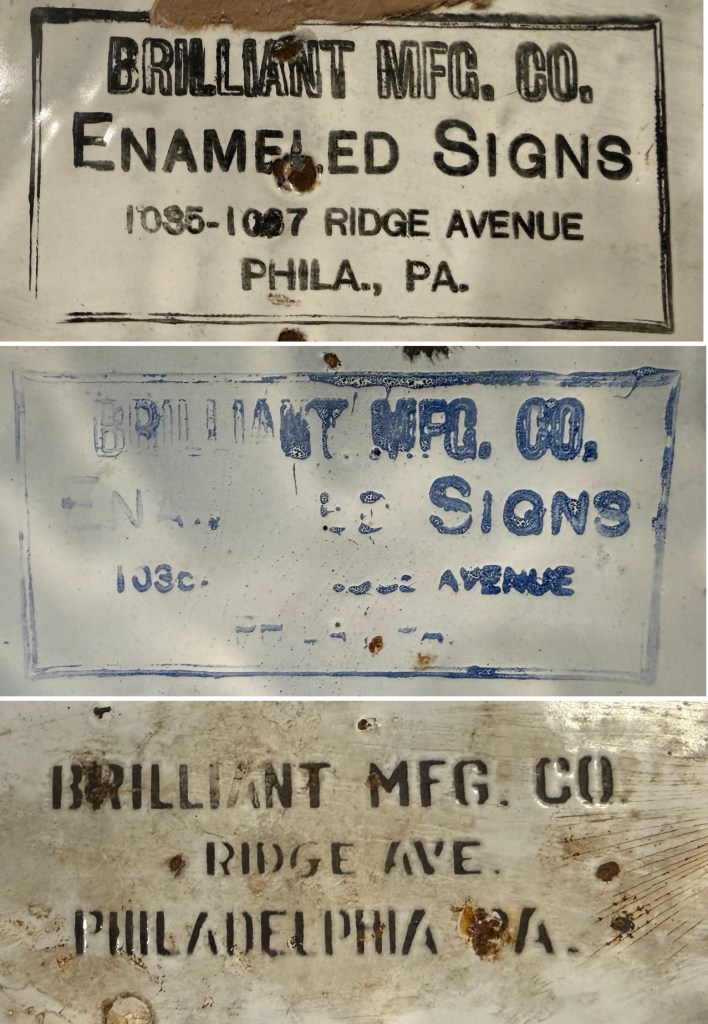
There is a “makers mark” stamped on the reverse of the plates. The style of this stamp changes multiple times throughout the year of production. Important? Maybe not, but plenty of collectors find this interesting!
I’ve decided to name the different styles:
| Style | Observed Range | Notes |
| “Black box” | 1-24,515, 43,183-44,347 | “Brilliant Mfg. Co. Enameled Signs 1035-1037 Ridge Avenue Phila, PA” in black ink, in box |
| “Blue box” | 24,903-40,429, 44,435-45,360 | Same as above, with blue/grey ink |
| “Small print” | 40,893-42,687, 45,551-49,365 | “Brilliant Mfg. Co. Ridge Ave Philadelphia, PA” |
| “Large print, rounded R” | 51,472-52,705, 55,322-57,597 | “Brilliant Mfg. Co. 1035 Ridge Ave. Philadelphia, PA.” “R” in Ridge is rounded |
| “Large print, square R” | 52,863-54,849, 57,714-59,406 | Same text, “R” is square |
You may have noticed that the stamp styles interchange several times. Any number of theories could apply – they ran out of ink, a different person was working their shift and applied the stamp differently, etc. There are also several examples that defy these known ranges. This data is based on general observation of physical plates, examples from fellow collectors, and from historic sales listings. It’s worth mentioning that I refer to it as a “stamp” collectively, but only the “box” varieties are ink stamps. The plain text has been physically stamped into the porcelain without ink.
“Re-fired” 1912 into 1913
Mis-print/Error plates
 Devlin's Collections